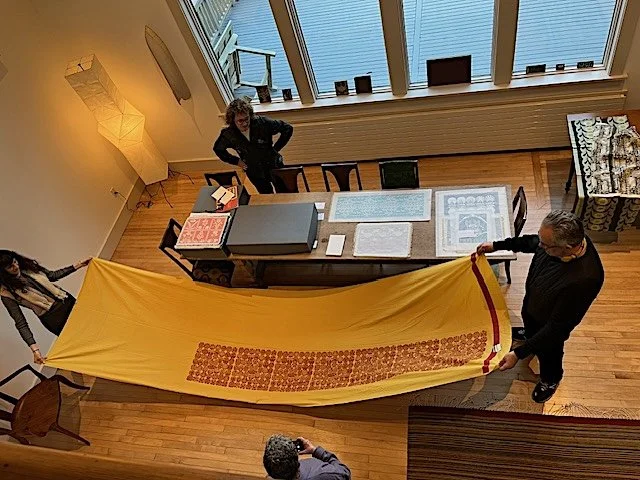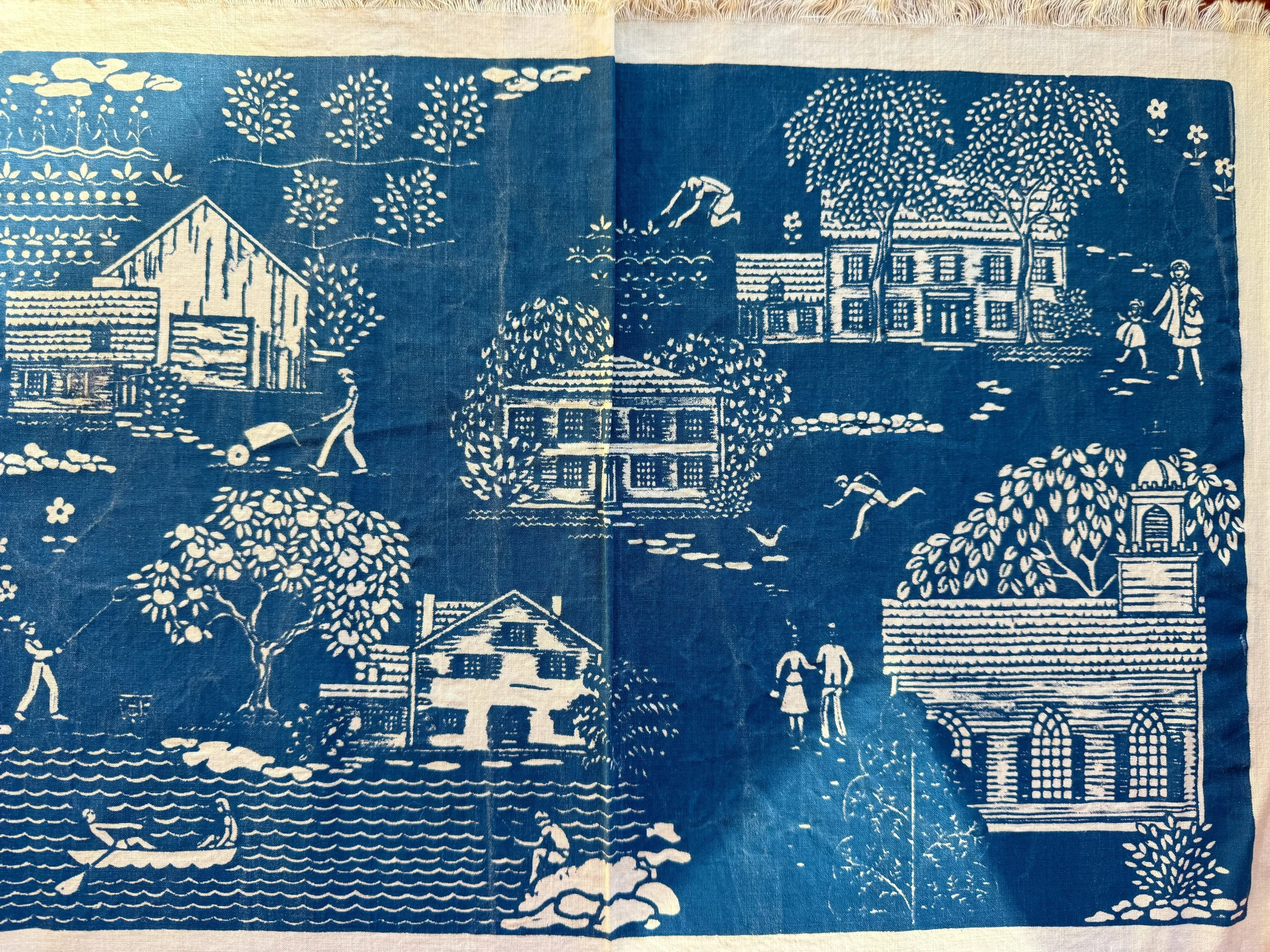
My essay for the Folly Cove Design exhibition at the School of Visual Arts, NYC, November 2024
Folly Cove has deceived some mariners. A basin with granite cliffs rising up to pine and oak woods on one side and rolling boulders on the other, it seems like a safe place to sit out a storm, but its northeast facing mouth traps violent seas that churn up against its banks in a Nor’easter.
Just twenty-five men in dories fished out of this place, and there was some rum running during Prohibition,1 but the cove’s essential dangers preserved its quiet. Around these undeveloped shores emerged a uniquely creative community, led by the children’s book author Virginia Lee Burton, unmatched for its spirit and the quality of its art.
The first artists to discover Folly Cove’s geographic and cultural charm was a flock of classical sculptors and painters with connections to the Pennsylvania Academy of Art. They built studios just short walks from each other. Sculptor George Demetrios - and his wife Virginia Lee Burton - arrived among this group in 1932.2
Husband and wife were both committed artists, but their styles differed. Demetrios worked in a European classical tradition and Burton cited the influence of printmaker and children’s book author Robert Hestwood, with whom she took classes as a teenager.3 She later studied at the California School of Fine Arts in San Francisco. Burton’s expressive figuration, and her embrace of story-telling, would recall the work of artists like Grant Wood and Thomas Hart Benton from the American Regionalism movement, powerful at the time.
In Folly Cove, Burton, then the mother of two small boys, wrote and illustrated children’s books, publishing five popular books in six years, and receiving the Caldecott Medal for The Little House in 1943.
Folly Cove and neighboring Lanesville were also home to a group of Finnish immigrants who came to work in the granite quarries. 4. Open summer windows meant the neighborhood awakened to the sound of hammers smashing cardamom pods for nisu, the beloved Finnish sweet bread. Saunas peppered the local woods. Finnish tradition, which held that household wares be as beautiful as they were functional, permeated generations in this community.5
Remarkably, these were Burton’s neighbors, the parents of her children’s friends, the people she invited to cookouts. This artist, deeply schooled in print and design, had made her home among people for whom craft mattered.
By 1938 Burton was teaching design classes to friends and neighbors; by 1941 they were officially the Folly Cove Designers.
The work ethic Burton (known to them as “Jinnee”), had demanded of herself she now demanded of the Folly Cove Designers, an ask that only activated the group to near zealouness.6 In 1943 they officially decided to operate like a medieval craft guild, and chose a set of rules and regulations that would guarantee the quality of the work. Burton refused to accept the title of president, but everyone understood who led them. 7
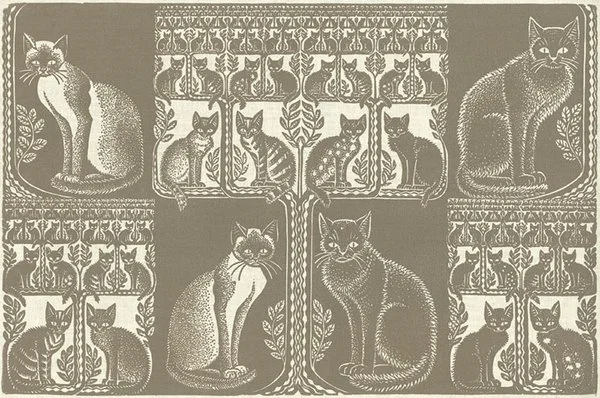
Zaidee & Her Kittens, Virginia Lee Burton Demetrios
The rules required each member produce one print a year. In autumn they met in Burton’s barn to take her design class and choose a subject for their block. Every member was required to take her design class every year, but no one complained. One reported, “we find new secrets in the darned thing every time.” 7
Burton encouraged members to source subjects intrinsic to their daily lives, no task, household item, or bird at the feeder was too ordinary. 8
She believed that an intimate attachment to a subject - the familiarity and love - would result in beautiful design.9
Pattern, the relationship of darks to lights, drawing from life were all lessons Burton required her students to understand.
Also size: Burton believed that equal sizes made stasis in a work, while unequal sizes created movement.10
She insisted that only by drawing a subject in hundreds of variations would the artist wholly understand it, and understanding was essential to beautiful design. 11
Burton’s attention to subject resulted in works that almost ironically recall other master artists for whom the minute details were part of the genius, such as the botanical still lives from 16th century Dutch and German artists. Burton printed “Zaidee and her Kittens,” a print which replicates Burton’s cat Zaidee and all her litters, in a tone finely mixed to exactly replicate the Siamese cat’s fur. This is one of Burton’s most complex and most popular prints; the hundreds of kittens loyally represent every variation of coloring Zaidee ever produced. Burton offered a free set of placemats to all kitten adoptees. 12
Burton also chose palettes based on the nearby seaweeds. 13 The natural world - the beauty and culture of Folly Cove - was their brand. And so was joy. Burton certainly recognized that design - like life - need not omit personality.
In the winter the members gathered before a “jury,” a small rotating group of their peers, to select designs for that year’s prints. Then came the carving of the blocks, which generally required one hundred hours of work. Lore says that for months Folly Cove members carried their blocks around “like another child,” carving anywhere they could, in any free minute they had. A local cookbook includes Burton’s hamburger dinner, which she describes as an easy meal to feed your family when you are busy carving your block. Families reported linoleum shards in the mashed potatoes.15
Spring brought new lambs in Folly Cove, and the printing of the blocks. They were inked, laid down on the selected fabric, and - true to Burton’s suspicion of machines - the artist jumped on the block, the simplest of printing presses.
Summer meant a public exhibition, with coffee and nisu, in a small wooden barn on the main road through Folly Cove. 16 To participate in this exhibition meant you had “passed” the class, completing the full cycle of design and work, resulting in an exquisite and functional product for sale. Each new graduate received a “diploma,” the Burton work, “How to Make A Block Print,” documenting the entire process. 17
As they became more popular the Folly Cove Designers graduated to Acorn presses. Soon the barn was open all summer, selling clothes, curtains, and placemats. Every article represented a member completing each step of the Folly Cove Designer process, except the fringing of the placemats, for which they recruited their children.
The Metropolitan and Smithsonian Museums purchased works. The designers established commercial contracts with F. Schumacher and Lord & Taylor. Life Magazine came to Folly Cove for a multi-page story, but renown did not make everyone comfortable. One company stole a Folly Cove design, so the group began patenting their images, and locking designs in a safe. A contract was cancelled when a china company asked to simplify a design for printing. 18
The culture of The Folly Cove Designers was almost as significant as its production. Many of the members were college educated, often in art. They were raising families, and yet they forced time out of their lives for this remarkably satisfying work. A direct line can be drawn from the Folly Cove Designers in Gloucester to the Bunting Institute at Radcliffe just miles away. The Bunting Institute was founded in 1961 to defeat a “climate of unexpectation” for women; its intent was to help educated women, who had stopped their careers to raise families, re-establish their work. 19 Jennifer Scanlon, Professor of Gender and Women’s studies at Bowdoin College, believes the Folly Cove Designers provided a map for the next decades of women’s organizations generating social change. 20
But perhaps the most remarkable moment in this history is the end: Burton became sick with lung cancer in the 1960’s; she died in 1968. The members agreed to never again print a Folly Cove Design. They sold the barn and donated everything - all their blocks to the Cape Ann Historical Society, now the Cape Ann Museum. Their animating spirit had been “Jinnee,” and she was gone.
This place, these people, and Virginia Lee Burton all came together in one of those singularly significant moments in art history. The textiles can be found in museums; The Wadsworth Museum of Art, Hartford, CT., The Peabody Essex Museum, Salem, MA, Boston’s Museum of Fine Arts, and the Smithsonian Museum in Washington, D.C. all include Folly Cove Designer textiles in their collections, and they are held in a number of private collections, but the spirit of it all is a story to be told. Jinnee would understand that.
ERKKILA, BARBARA. Village at Lane’s Cove. Gloucester, MA, Ten Pound Book Company, 1989. p. 107.
Ibid. pp. 141 - 170.
SARNI, ELENA. Trailblazing Women Printmakers, VIrginia Lee Burton Demetrios and the Folly Cove Designers. New York, Princeton Architectural Press, 2023. p. 35
ST. GERMAIN, PAUL. Cape Ann Granite. Charleston, SC, Arcadia Publishing, 2015. p. 8.
Sarni, p. 21.
GIAIMO, CARA. “The Unlikely Story of the Folly Cove Guild, the Best Designers You’ve Never Heard Of.” Atlas Obscura, June 14, 2017. https://www.atlasobscura.com/articles/the-unlikely-story-of-the-folly-cove-guild-the-best-designers-youve-never-heard-of.
Sarni, pp. 22-26
Giaimo.
Ibid.
Sarni, p. 42.
Giaimo.
Sarni, p. 123
Giaimo.
Ibid.
Ibid.
Ibid.
Ibid.
Ibid.
DOHERTY, MAGGIE. The Equivalents A Story of Art, Female Friendship, and Liberation in the 1960s. New York, NY, Vintage Press, 2021. Introduction p. xii.
SCANLON, JENNIFER. “‘The Space Between’: Rediscovering the Folly Cove Designers.” The Massachusetts Review, vol. 56, no. 2, 2015, pp. 282–301. JSTOR, http://www.jstor.org/stable/24494497.
BIBLIOGRAPHY:
ERKKILA, BARBARA. Village at Lane’s Cove. Gloucester, MA, Ten Pound Book Company, 1989.
GIAIMO, CARA. “The Unlikely Story of the Folly Cove Guild, the Best Designers You’ve Never Heard Of.” Atlas Obscura, June 14, 2017. https://www.atlasobscura.com/articles/the-unlikely-story-of-the-folly-cove-guild-the-best-designers-youve-never-heard-of. Accessed 21 Aug. 2024
SARNI, ELENA. Trailblazing Women Printmakers, VIrginia Lee Burton Demetrios and the Folly Cove Designers. New York, Princeton Architectural Press, 2023.
SCANLON, JENNIFER. “‘The Space Between’: Rediscovering the Folly Cove Designers.” The Massachusetts Review, vol. 56, no. 2, 2015, pp. 282–301. JSTOR, http://www.jstor.org/stable/24494497. Accessed 21 Aug. 2024.
ST. GERMAIN, PAUL. Cape Ann Granite. Charleston, SC, Arcadia Publishing, 2015.
VAIL, JUNE. Folly Cove Sketches. Thomaston, ME, Custom Museum Publishing, 2022. P. 74 - cats